How Long Do You Have to File a Wrongful Termination Claim in California?
There is no single wrongful termination deadline in California. Each type of claim carries its own clock, and the shortest one that applies to you is the one that matters most.
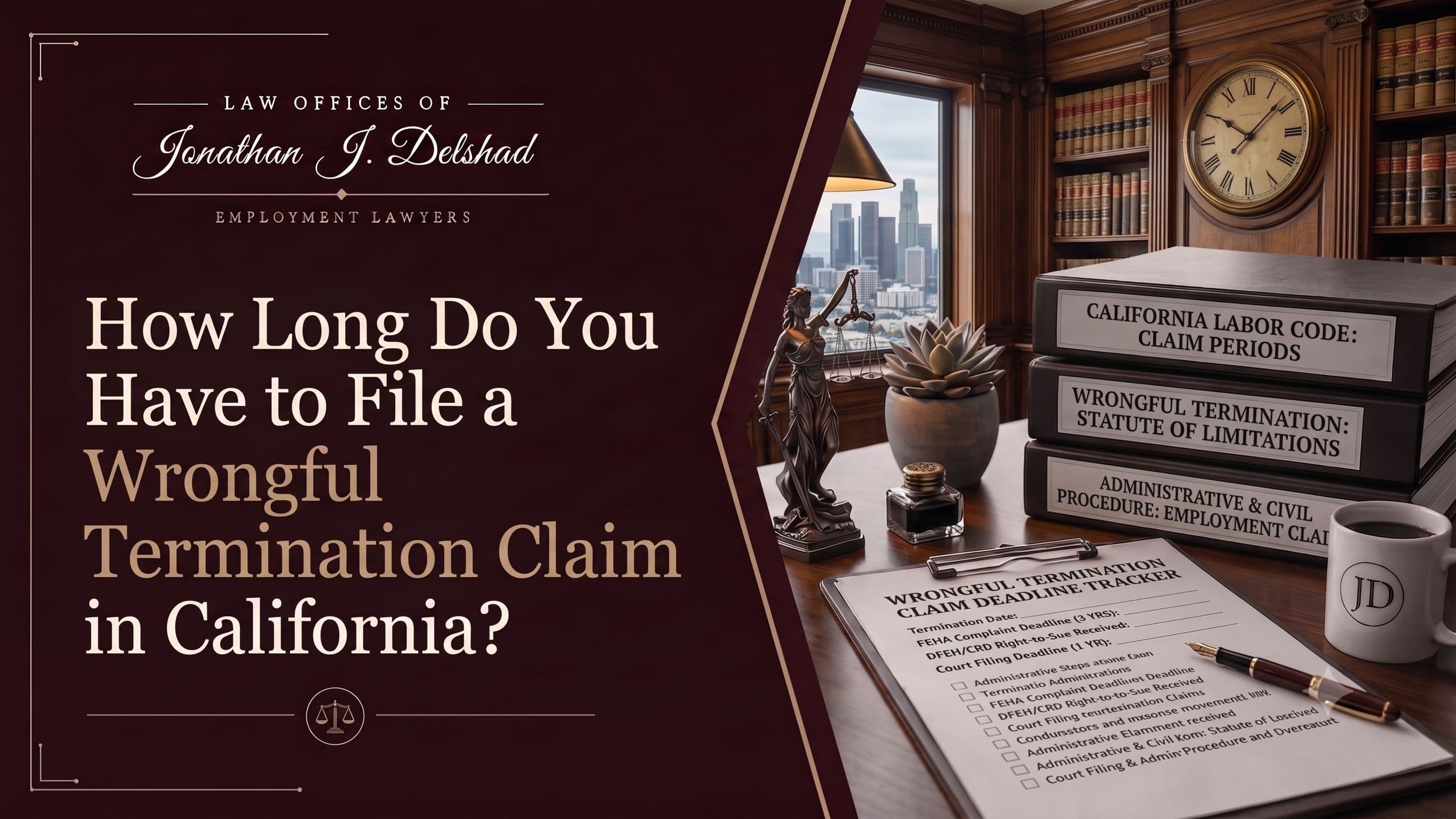
There is no single wrongful termination deadline in California. Each type of claim carries its own clock, and the shortest one that applies to you is the one that matters most.
It depends on the type of claim, and the deadlines range from as little as a few months to a few years. There is no single wrongful termination deadline in California, because a firing can involve several different legal claims, each with its own clock. Miss the shortest one that applies to you, and that piece of your case can be lost for good. The safest approach is simple: assume the clock is already running, and talk to a lawyer promptly rather than trying to calculate the date yourself.
At a glance
- There is no single deadline. Different claims carry different limits, generally ranging from about two to four years, with some administrative and federal deadlines much shorter.
- Discrimination, harassment, and retaliation claims under state law generally require filing with a government agency within three years, then suing within one year of the right-to-sue notice.
- A public-policy wrongful termination claim generally must be filed within two years.
- These clocks can start on different dates and some run early, so confirm your specific deadlines with a lawyer instead of relying on a guide.
| What people assume | What California law says |
|---|---|
| There is one deadline for wrongful termination | It depends on the claim: three years to the CRD, two for a public policy claim, four on a written contract |
| You can go straight to court on a discrimination claim | A complaint to the Civil Rights Department comes first |
| The right to sue notice can wait | You have one year from the date of that notice |
| Federal and state deadlines are the same | A federal charge runs 300 days in California, then 90 days to sue after the notice |
How long do you have to file a wrongful termination claim in California?
Generally two to four years, depending on the legal theory, with some steps due much sooner. Because most wrongful terminations involve more than one possible claim, the practical rule is that the shortest deadline that applies to your situation is the one that matters most. Here is how the main deadlines break down.
Discrimination, harassment, and retaliation (FEHA)
If your firing was based on a protected characteristic, or was retaliation for protected activity, it likely falls under California's Fair Employment and Housing Act (FEHA). For these claims you generally have three years from the unlawful act to file an administrative complaint with the California Civil Rights Department (CRD) (formerly DFEH). That filing is mandatory before you can sue. Once the CRD issues a right-to-sue notice, a separate one-year clock starts for filing your lawsuit in court, and that deadline is firm. So the FEHA path is really two deadlines: three years to file with the agency, then one year to sue after you get the notice. For the agency stage itself, from intake form to notice, see how to sue your employer in California.
Wrongful termination in violation of public policy
If you were fired for a reason that offends a fundamental public policy, such as reporting illegal conduct, refusing to break the law, or exercising a legal right, that is a common-law claim often called a Tameny claim. It generally must be filed in court within two years of your termination. You usually do not have to go through an agency first for this one, but the two-year clock is shorter than the FEHA filing window, which matters when a firing involves both theories. The case that created the Tameny claim opens our ten California wrongful termination examples.
Breach of contract
If your termination broke an employment contract, the deadline depends on the type of contract. A written contract generally carries a four-year deadline, while an implied or oral contract is generally two years. These claims turn on the specific terms and how they were made.
Whistleblower retaliation
If you were fired for reporting a suspected violation of law, a claim under California's general whistleblower statute generally carries a three-year deadline for a civil lawsuit. Some whistleblower protections involve separate agency processes with their own, often shorter, time limits.
Federal claims (EEOC)
If you also pursue a federal discrimination claim, the federal deadline is much shorter. You generally must file a charge with the Equal Employment Opportunity Commission (EEOC) within 300 days in California, and then, after a federal right-to-sue notice, you have only 90 days to file suit. These federal clocks are far tighter than the state ones, which is another reason not to wait.
Why timing is so critical
Because a missed deadline can end a strong case before it starts. Several things make this trickier than it looks. The clocks can start on different dates, sometimes the termination date, sometimes when you discovered the harm. An internal complaint or appeal usually does not pause them. And the shortest applicable deadline controls what you can still bring. If you worked for a city, county, school district, or other public agency, different and often shorter deadlines can apply. That is why the very first step in any wrongful termination matter should be figuring out every clock that applies to you. Do not calendar a date from a guide like this one. Confirm it with a lawyer against your actual facts.
What to do to protect your deadlines
- Assume the clock is already running from your termination date.
- Write down key dates: your firing, any complaints or requests you made, and when you learned of any harm.
- Gather your documents early, but do not delay talking to a lawyer while you collect them.
- Contact an employment lawyer promptly so every applicable deadline can be identified and protected.
One question this page does not answer is how long the case itself takes once it has been filed. That is a different clock, set by the court’s calendar rather than by a statute of limitations. How long does an employment lawsuit take in California covers it.
Frequently asked questions
How long do you have to file a wrongful termination claim in California?
It depends on the claim, generally two to four years, with some steps due sooner. FEHA discrimination and retaliation claims allow three years to file with the CRD and one year to sue after the right-to-sue notice. Public-policy claims are generally two years. Confirm your specific deadlines with a lawyer.
Do I have to file with a government agency before I sue?
For FEHA discrimination, harassment, and retaliation claims, yes. You must file with the CRD and obtain a right-to-sue notice first. Public-policy and contract claims generally go straight to court.
What is the deadline for a public-policy wrongful termination claim?
Generally two years from the date of termination. This covers firings for reasons like whistleblowing or refusing to do something illegal.
Does filing an internal complaint or appeal extend my deadline?
Usually not. Internal grievances generally do not pause the legal clocks, so you can pursue an internal process and still lose your right to sue if you wait too long.
What if I already think I am past a deadline?
Talk to a lawyer anyway. The start date, the type of claim, and certain exceptions can affect whether a deadline has truly passed. Do not assume without checking.
Not sure how much time you have left?
Because wrongful termination deadlines are short, overlapping, and easy to miscalculate, the safest move is to talk to a lawyer promptly so every applicable clock is identified. We represent employees, only employees, across California, and most of our work is in Los Angeles. The consultation is free. We handle most employment cases on a contingency-fee basis: you do not pay an attorney's fee unless we recover for you, and you are not responsible for the costs we advance if there is no recovery. We will explain the specific fee terms in writing before you decide to move forward. On the value side, the settlement figures circulating online are drawn from public verdicts rather than measured averages.
Call (424) 255-8376 or contact us for a free, confidential case review.
The Law Offices of Jonathan J. Delshad is a Los Angeles based employment law firm representing employees across California in wrongful termination, discrimination, retaliation, harassment, and wage and hour matters. Representing employees is the core of the firm's practice. Mr. Delshad is a lifetime member of the California Employment Lawyers Association (CELA), serves as Editor-in-Chief of the California Wrongful Termination Law Review, and trained at Latham & Watkins. Recognition includes Super Lawyers (2022 to 2027), Best Lawyers (since 2017), and an Avvo 10.0 "Superb" rating. Reviewed for California employment law accuracy. Last updated: July 30, 2026.
Attorney advertising. This article is educational only and is not legal advice. Reading it does not create an attorney-client relationship, which exists only under a signed engagement agreement. Every case is different, and outcomes depend on the specific facts. Deadlines can run early, so consult a lawyer promptly about your situation.