What Happens After You Contact an Employment Lawyer: Intake to Resolution, Step by Step
It starts with a free, confidential consultation, most cases settle without trial, and here is the full path from intake to resolution in California. This is the path at the Law Offices of Jonathan J. Delshad.
It starts with a free, confidential consultation, most cases settle without trial, and here is the full path from intake to resolution in California. This is the path at the Law Offices of Jonathan J. Delshad.
Reaching out to an employment lawyer can feel like a big step, so it helps to know what actually happens next. The short version: it starts with a free, confidential conversation, there is no obligation, and most cases never see a courtroom. From there, a case moves through a predictable series of stages, and many resolve through negotiation or settlement rather than trial. Here is the whole path, start to finish, and an honest answer about how long it takes. This is the path at the Law Offices of Jonathan J. Delshad, a Los Angeles firm that represents employees only.
At a glance
- It begins with a free, confidential consultation. You are under no obligation, and what you share is protected.
- Most employment cases are handled on a contingency-fee basis, which means no attorney's fee unless there is a recovery.
- The large majority of cases resolve through negotiation, mediation, or settlement. Trials are the exception, not the rule.
- Timelines vary widely. Some matters resolve in a few months, while litigated cases often take a year or more.
What happens when you first contact an employment lawyer?
You have a conversation, not a commitment. The first step is a consultation, which is free and confidential. You describe what happened, and the lawyer listens, asks questions, and gives you an initial sense of your situation and options. You are not signing up for anything by having this conversation, and there is no obligation to move forward. If the firm is not the right fit, or if there is not a viable claim, a good lawyer will tell you that too. What you share in a consultation is treated as confidential.
Bring what you have: your timeline of events, any termination or severance paperwork, pay records, and relevant emails or messages. The more organized you are, the more useful the conversation.
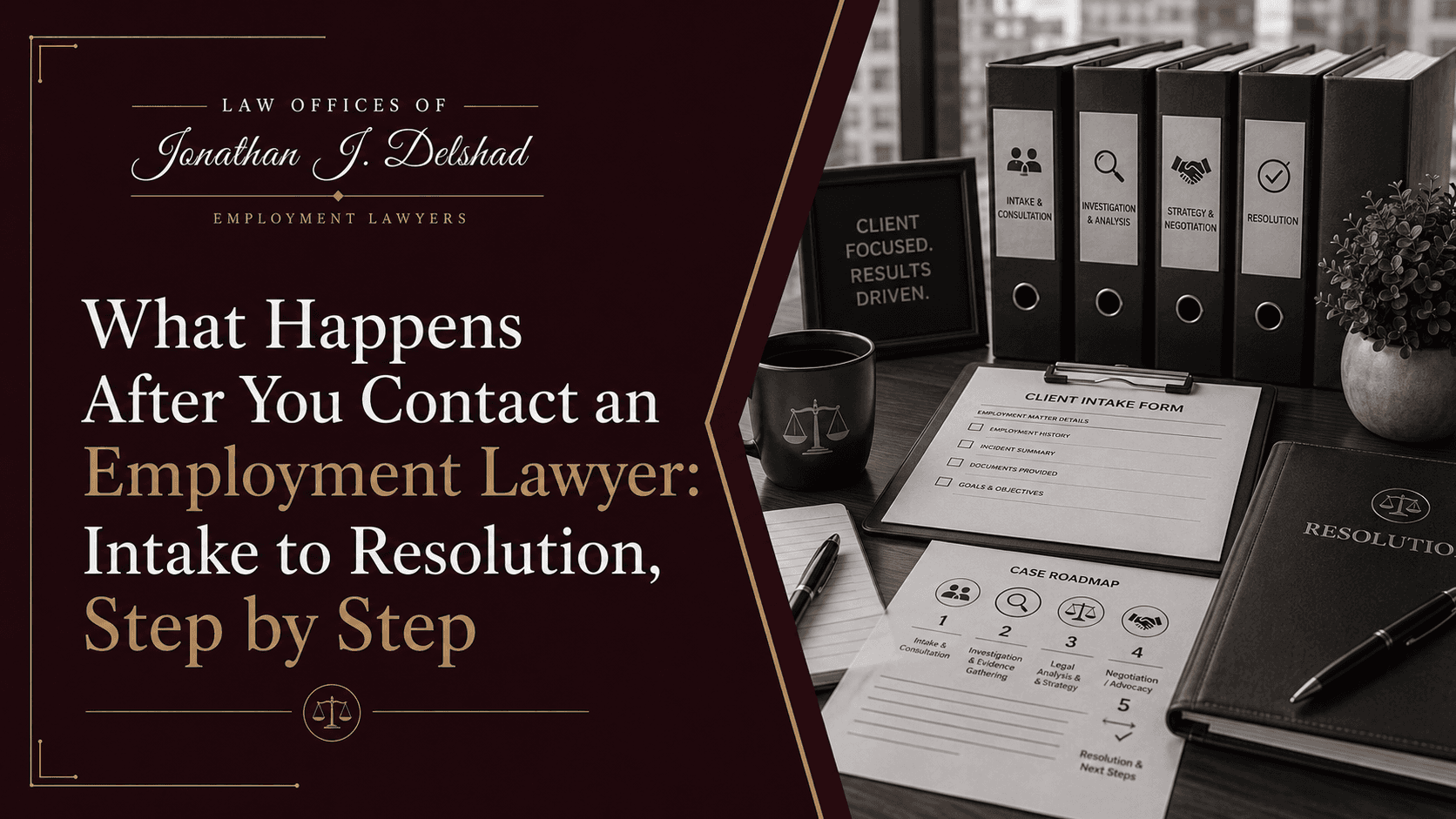
The process, step by step
Step 1: The free consultation
You tell your story and the lawyer evaluates it at a high level. This is where you learn whether the firm can help and what the general path might look like. Ask your questions here, including about fees and timing.
Step 2: Case evaluation and the fee agreement
If the firm takes your case, you sign a written engagement agreement that spells out the fee terms. Most employment cases are handled on a contingency-fee basis: you do not pay an attorney's fee unless there is a recovery, and you are not responsible for the costs advanced if there is no recovery. Some matters, like a severance agreement review, are handled instead as focused, flat-fee work. Either way, the specific fee terms are explained in writing before you decide to move forward. An attorney-client relationship begins only when that agreement is signed.
Step 3: Investigation and preserving evidence
Your lawyer digs into the facts: the timeline, the documents, the witnesses, and the applicable law. This is also when preserving evidence matters most. You will be asked to save relevant records and to stop doing anything that could compromise the case, such as posting about it online or accessing company systems after you have left.
Step 4: Administrative steps, where required
Some claims must go through a government agency before they can be filed in court. For discrimination, harassment, and retaliation claims under state law, that usually means filing with the California Civil Rights Department and obtaining a right-to-sue notice. Your lawyer handles these filings and the deadlines that come with them.
Step 5: The demand letter and pre-litigation negotiation
In many cases, the next step is a demand letter to the employer laying out the facts, the legal claims, and what it would take to resolve the matter. A strong demand reflects real investigation, not just a threat to sue. A meaningful share of cases settle at this stage, before any lawsuit is filed.
Step 6: Filing a lawsuit or arbitration
If the matter does not resolve, your lawyer files a complaint in court, or initiates arbitration if you signed an arbitration agreement. This formally starts the case, and the employer responds. If you are not sure whether you signed one, or what it changed, what an arbitration agreement actually does to your claims walks through it.
Step 7: Discovery
Both sides exchange information and evidence through documents, written questions, and depositions, which are recorded question-and-answer sessions under oath. Discovery is often the longest phase, and it is where the facts get tested and the case takes shape.
Step 8: Mediation and settlement
Most cases resolve here. Mediation is a structured negotiation with a neutral third party who helps the sides reach a settlement. The large majority of employment cases settle at some point rather than going to trial, and you decide whether to accept any offer. Your lawyer advises, but the decision to settle is always yours.
Step 9: Trial, if it is needed
If a fair resolution is not reached, the case can go to trial before a judge or jury. Trials are less common and take longer, but preparing as if a case may go to trial is part of building leverage to resolve it well.
Step 10: Resolution
The case ends in a settlement or a judgment. Your lawyer explains what you receive, how any fees and advanced costs are handled under your agreement, and what the tax treatment may look like.
How long does an employment case take in California?
It varies widely, and anyone who promises a specific timeline is guessing. A matter that resolves through a demand letter and negotiation might conclude in a few months, while a litigated case often takes a year or more, and one that goes all the way to trial can take longer still. How long does an employment lawsuit take in California walks through the courts’ own targets, the statutory ceiling of five years to trial, and what makes one case slower than another.
What does it cost to hire an employment lawyer?
For most employment cases, nothing up front. The consultation is free. We handle most employment cases on a contingency-fee basis: you do not pay an attorney's fee unless we recover for you, and you are not responsible for the costs we advance if there is no recovery. Some matters, such as a severance review, are handled as a focused, flat-fee engagement instead. We explain the specific fee terms in writing before you decide to move forward, so there are no surprises.
What you can do to help your case
- Write a dated timeline of events while it is fresh.
- Save relevant documents and messages, and keep your own copies.
- Do not post about your situation on social media.
- Do not access company systems or take confidential company data after you leave.
- Meet the deadlines your lawyer gives you, and ask questions whenever you are unsure.
Frequently asked questions
How long does an employment case take in California?
It varies. Some matters resolve in a few months through a demand and negotiation, while litigated cases often take a year or more, and trials take longer. The timeline depends on the facts, the court, and whether the case settles.
Does it cost anything to talk to an employment lawyer?
No. At the Law Offices of Jonathan J. Delshad the initial consultation is free and confidential, and you are under no obligation to move forward.
What is a contingency fee?
An arrangement in which you do not pay an attorney's fee unless there is a recovery, and you are not responsible for the advanced costs if there is no recovery. The Law Offices of Jonathan J. Delshad handles most employment cases this way.
Will my case go to trial?
Usually not. The large majority of employment cases resolve through negotiation, mediation, or settlement. Trials happen, but they are the exception.
When does the lawyer become "my lawyer"?
When you sign a written engagement agreement. A consultation alone, even a detailed one, does not by itself create an attorney-client relationship.
Ready to talk it through?
If something happened at work and you want to understand your options, the first conversation is free and confidential, with no obligation. The Law Offices of Jonathan J. Delshad represents employees, only employees, across California, and most of the firm's work is in Los Angeles. We handle most employment cases on a contingency-fee basis: you do not pay an attorney's fee unless we recover for you, and you are not responsible for the costs we advance if there is no recovery. We will explain the specific fee terms in writing before you decide to move forward.
Call (424) 255-8376 or contact us for a free, confidential consultation.
The Law Offices of Jonathan J. Delshad is a Los Angeles based employment law firm representing employees across California in wrongful termination, discrimination, retaliation, harassment, and wage and hour matters. Representing employees is the core of the firm's practice. Mr. Delshad is a lifetime member of the California Employment Lawyers Association (CELA), serves as Editor-in-Chief of the California Wrongful Termination Law Review, and trained at Latham & Watkins. Recognition includes Super Lawyers (2022 to 2027), Best Lawyers (since 2017), and an Avvo 10.0 "Superb" rating. Reviewed for California employment law accuracy. Last updated: July 20, 2026.
Attorney advertising. This article is educational only and is not legal advice. Reading it does not create an attorney-client relationship, which exists only under a signed engagement agreement. Every case is different, and outcomes depend on the specific facts. Deadlines can run early, so consult a lawyer promptly about your situation.