Average Wrongful Termination Settlement in California: What the Numbers Actually Show
There is no verifiable average. Settlements are confidential and verdicts are public, so every figure online is built from the small share of cases that went to trial.

There is no verifiable average. Settlements are confidential and verdicts are public, so every figure online is built from the small share of cases that went to trial.
There is no verifiable average. Settlement agreements are private contracts, and nearly all of them are confidential, so the amounts never enter the public record. Only cases that reach a verdict produce a published number. Every "average settlement" figure circulating online is therefore built from the small, unrepresentative share of cases that went all the way to trial.
At a glance
If you landed here after reading that the average California wrongful termination settlement is some specific figure, here is the part those pages leave out.
- The number was not measured. No agency, court system, or research body publishes settlement amounts for California wrongful termination cases. There is no dataset to average.
- Published verdicts are the visible minority. They are public because a jury announced them in open court. The settlements sitting alongside them are invisible by design.
- Verdicts skew high, and they are not what gets paid. A headline verdict can be cut by the trial judge, reduced on appeal, or settled for less while the appeal is pending.
- The one checkable dataset points much lower than the headlines. Federal enforcement figures work out to tens of thousands of dollars per person. Millions are the exception.
- What your own claim is worth turns on your own facts: your lost pay, the kind of claim you have, and what the evidence shows about why you were fired. No average can supply that.
| What people assume | What California law says |
|---|---|
| A published average settlement is a real benchmark | Settlements are confidential, so the figures circulating come from public verdicts |
| A verdict is what the employee takes home | A verdict can be cut by the judge, reduced on appeal, or settled for less |
| California caps damages the way federal law does | FEHA sets no dollar cap on compensatory or punitive damages |
| National average figures apply to a California claim | Federal law caps combined damages at $50,000 to $300,000 by employer size |
| Punitive damages are a normal add-on | They need clear and convincing evidence of oppression, fraud or malice |
Why is there no reliable average wrongful termination settlement in California?
Because of how the two kinds of resolution work.
A verdict is a decision announced by a jury or judge in open court. It goes into the public record. Anyone can read it and quote it.
A settlement is a private agreement to end the case. The employer pays, the employee signs a release, and the agreement almost always includes a confidentiality clause covering the amount. Nobody outside the case learns the number.
Now think about what that does to any "average" built from the public side. The cases you can see are the ones that went the distance: strong enough facts to survive years of litigation, a plaintiff willing to testify, and a defendant unwilling to pay to make it stop. Those are not typical cases. Averaging them tells you what an outlier looks like, not what your situation is worth.
This is why the pages competing for this exact search look the way they do. Most of them list a handful of large verdicts, ranging from a couple of million to tens of millions, without saying where a single figure came from or that they are verdicts rather than settlements. Those numbers are real in the sense that some case somewhere produced them. They are not a benchmark.
What do the published numbers actually show?
One dataset in this space is genuinely published and checkable: the Equal Employment Opportunity Commission (EEOC) reports what it recovers each year.
In its fiscal year 2025 report, released in April 2026, the EEOC said it recovered $660 million for 17,680 people. Divide one by the other and you get roughly $37,300 per person. That division is ours rather than a statistic the EEOC publishes, but the two figures it rests on are the agency's own.
The breakdown is more revealing than the total:
- $528 million came from pre-litigation enforcement, meaning it was resolved before anyone filed a lawsuit. That was the highest such figure in the agency's 60-year history.
- $52.5 million came through conciliation, up 24 percent on the prior year.
- $27 million came from actual litigation, shared among 2,505 individuals, which works out to roughly $10,800 each.
- The agency processed 88,201 new charges and resolved 90,743.
Read those numbers carefully before you carry them anywhere. They are nationwide rather than Californian. They cover every kind of discrimination charge, wrongful termination among them. They mix administrative resolutions with litigated ones. They are not a settlement average for your claim.
What they are good for is calibration. The only large, transparent body of employment-claim recoveries in the country runs to tens of thousands of dollars per person. Any page telling you the "average" California wrongful termination settlement is seven figures is describing something other than what typically happens.
What is the difference between a settlement and a verdict?
The distinction matters more than any dollar figure on this page.
A verdict is what a jury awards. It is public, it is often large, and it is the number that ends up in headlines. It is also not final. The trial judge can reduce it. An appellate court can cut it or order a new trial. Many large verdicts are quietly resolved for a fraction of the announced figure while the appeal runs.
A settlement is a negotiated payment. It is faster, it is certain, and it removes the risk of losing at trial after years of litigation. It is also almost always confidential, which is precisely why you cannot look up what similar cases settled for.
When a firm advertises a large number, it is worth knowing which of the two you are looking at. Our own published record is a case in point: the firm has recovered $26M+ for clients, and our lead verdict is $7.6M in a whistleblower retaliation case. That verdict figure is public because a jury returned it. In one matter where the amount is published, *Michael Grant v. LA MTA*, the case settled for $800,000. Those are three different kinds of number, and only the last one is a settlement.
What actually moves the number in a California wrongful termination case?
Since there is no average to apply to you, the useful question is what drives value in the claim you actually have. It varies by claim type.
Discrimination and retaliation claims under California's Fair Employment and Housing Act (FEHA). These tend to carry the widest range, for two structural reasons. Which protected characteristic is involved shapes the evidence more than the value, and the eight most common types of workplace discrimination sets out what each one looks like in practice. California sets no dollar cap on compensatory or punitive damages in a FEHA case. And under Government Code section 12965(c)(6), a court may award the prevailing party reasonable attorney's fees and costs, including expert witness fees. A prevailing employer, by contrast, only recovers fees if the court finds the case was "frivolous, unreasonable, or groundless when brought." That asymmetry is deliberate, and it changes the arithmetic an employer does when deciding whether to fight.
Whistleblower retaliation claims under Labor Code section 1102.5. These add a distinct layer. Subdivision (f) makes an employer liable for a civil penalty of up to $10,000 per employee for each violation, and subdivision (j) authorizes the court to award reasonable attorney's fees to a plaintiff who brings a successful action. Where the retaliation was systematic or affected more than one person, the penalty exposure stacks. California's retaliation laws explain what counts as protected activity in the first place.
Public policy (wrongful discharge) claims. These are the classic "fired for a reason the law forbids" claims that exist outside any specific statute. Value here is driven mostly by lost pay and emotional harm rather than statutory penalties.
Contract claims. If you had a written employment agreement that was broken, the measure is usually what the contract promised, which makes these the most predictable and often the narrowest.
Across all four, three inputs do most of the work:
- Lost pay. How much you earned, how long you were out of work, and what you earn now. A senior employee out of work for eighteen months has a larger wage claim than a junior employee re-hired in six weeks, on identical facts.
- Emotional harm. Real, provable, and highly fact-dependent.
- Punitive damages. Available, but hard. Civil Code section 3294 requires proof by clear and convincing evidence that the employer was guilty of oppression, fraud, or malice. "Malice" means conduct intended to cause injury, or despicable conduct carried on with a willful and conscious disregard of others' rights. That is a demanding standard, not a routine add-on.
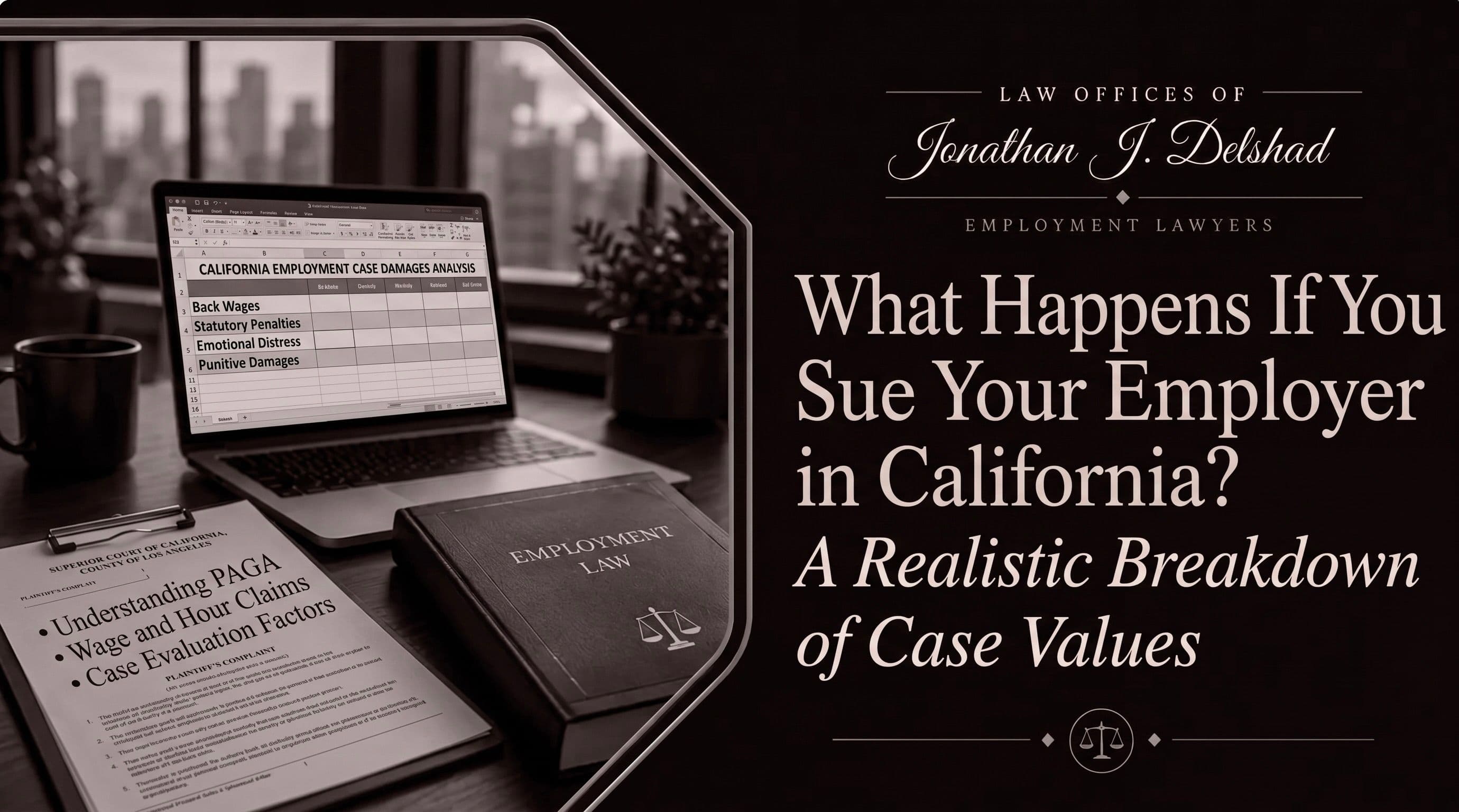
For the full anatomy of how these pieces combine into a number, and what you actually take home after fees and taxes, our realistic breakdown of employment case values goes through it step by step.
Why can California cases be worth more than federal ones?
Because the federal statute has a ceiling and the California one does not.
Under federal law, 42 U.S.C. section 1981a(b)(3) caps the combined total of compensatory and punitive damages per complaining party by employer size: $50,000 for employers with 15 to 100 employees, $100,000 for 101 to 200, $200,000 for 201 to 500, and $300,000 for employers with more than 500. Those caps have not moved in decades.
FEHA contains no equivalent cap. This is the single largest reason national "average payout" figures translate badly to California, and one reason a California employee's claim is often brought under state law rather than federal law.
Ready to talk it through?
If you are reading this because you were fired and you are trying to work out whether it is worth doing anything about it, an average was never going to answer that. Your facts will. A short conversation can tell you which claim types your situation actually fits, what the realistic range looks like for that kind of claim, and what evidence would strengthen or weaken it. Representing employees is the core of our practice, we work on a contingency basis, and the first conversation costs nothing. If you want to know what happens after that call, we have written up the whole process, from intake to resolution.
How long do you have to file?
This is the part that quietly ends more claims than any valuation question, so check your dates before you do anything else.
Discrimination and retaliation claims under FEHA require an administrative complaint to the California Civil Rights Department (CRD) (formerly DFEH), generally within three years of the unlawful act. Once the CRD issues a right-to-sue notice, a separate one-year clock starts for filing the lawsuit itself. A public policy wrongful termination claim generally carries a two-year deadline. If you file a charge with the EEOC instead, the window in California is 300 days, and only 90 days to sue once you receive the federal right-to-sue notice. Employees of government agencies face substantially shorter deadlines.
How long do you have to file a wrongful termination claim in California? walks through each deadline in detail. Some of these clocks start earlier than people assume, so confirm your dates promptly rather than waiting until you have decided what to do.
If you are still working out whether what happened to you was unlawful at all, 10 real examples the courts took seriously and when a layoff is actually wrongful termination are the better starting points.
Frequently asked questions
What is the average wrongful termination settlement in California?
There is no verifiable average. Settlement amounts are almost always confidential under the agreement that ends the case, so they never become public and cannot be counted. The figures published online are drawn from jury verdicts, which are public precisely because they went to trial, and trials are a small and unrepresentative share of cases. Any specific "average settlement" number you read for California wrongful termination was not measured against a real dataset.
Why do law firm websites list million-dollar wrongful termination numbers?
Because verdicts are public and settlements are not. A firm can name a multimillion-dollar verdict because a jury announced it in open court. It usually cannot name a settlement, because the agreement forbids it. The result is that the numbers available to publish are systematically the largest and least typical outcomes, and many pages present them without saying they are verdicts rather than settlements.
Is a verdict the same as what the employee actually receives?
No. A verdict is the jury's award before the trial judge rules on post-trial motions, before any appeal, and before attorney's fees, costs, and taxes. Judges reduce verdicts. Appellate courts reduce or overturn them. Cases with large verdicts are frequently resolved for less while the appeal is pending. The announced figure and the amount that reaches the employee are often quite different.
What is the difference between a settlement and a verdict in California?
A verdict is a decision by a jury or judge at the end of a trial, entered in the public record. A settlement is a private agreement to resolve the case before that point, usually including a confidentiality clause covering the amount. Settlements are faster and certain; verdicts are public and carry the risk that either side loses outright and appeals.
Does California cap wrongful termination damages?
FEHA sets no dollar cap on compensatory or punitive damages. Federal law does: 42 U.S.C. section 1981a(b)(3) caps combined compensatory and punitive damages per complaining party at $50,000 to $300,000 depending on employer size. This difference is a large part of why national average-payout figures do not transfer to California cases.
What makes a California wrongful termination case worth more?
Mainly the size of the wage loss, the strength of the evidence about why you were fired, and the claim types your facts support. Whistleblower retaliation claims under Labor Code section 1102.5 carry a civil penalty of up to $10,000 per employee for each violation, plus attorney's fees for a successful plaintiff. FEHA claims allow fee recovery under Government Code section 12965(c)(6) and are not capped. Punitive damages are possible but demanding, requiring clear and convincing evidence of oppression, fraud, or malice under Civil Code section 3294.
How much do employment claims typically recover?
The only large published dataset is federal. In fiscal year 2025 the EEOC reported recovering $660 million for 17,680 people, which works out to roughly $37,300 each; its litigation program alone recovered $27 million for 2,505 individuals, roughly $10,800 each. Those figures are nationwide and cover all discrimination charge types rather than California wrongful termination specifically, so treat them as a reality check on seven-figure headlines rather than as a prediction for your claim.
Should I ask a lawyer what my case is worth before I file?
Yes, and expect a range rather than a number. A lawyer who has your termination documents, your pay history, and the timeline can tell you which claims your facts support and what drives the value up or down. Deadlines can run early, so it is worth having that conversation before the filing windows close rather than after.
The Law Offices of Jonathan J. Delshad is a Los Angeles based employment law firm representing employees across California in wrongful termination, discrimination, retaliation, harassment, and wage and hour matters. Representing employees is the core of the firm's practice. Mr. Delshad is a lifetime member of the California Employment Lawyers Association (CELA), serves as Editor-in-Chief of the California Wrongful Termination Law Review, and trained at Latham & Watkins. Recognition includes Super Lawyers (2022 to 2027), Best Lawyers (since 2017), and an Avvo 10.0 "Superb" rating. Reviewed for California employment law accuracy. Last updated: August 6, 2026.
Attorney advertising. This article is educational only and is not legal advice. Reading it does not create an attorney-client relationship, which exists only under a signed engagement agreement. Every case is different, and outcomes depend on the specific facts. Deadlines can run early, so consult a lawyer promptly about your situation.