Workplace Retaliation in California: The Laws That Protect You After You Speak Up
Workplace retaliation in California means being punished for something the law protects you for doing, such as reporting harassment, discrimination or unpaid wages. It is not limited to being fired, and several overlapping laws cover it. Here is which law fits which complaint, what counts as a punishing action, and why the timing of what happened to you is often the strongest evidence in the file.

Workplace retaliation in California means being punished for something the law protects you for doing, such as reporting harassment, discrimination or unpaid wages. It is not limited to being fired, and several overlapping laws cover it. Here is which law fits which complaint, what counts as a punishing action, and why the timing of what happened to you is often the strongest evidence in the file.
Workplace retaliation in California means your employer punished you for doing something the law protects, such as reporting harassment or discrimination, asking for an accommodation, taking protected leave, or raising a wage or safety problem. It is not limited to being fired. Several overlapping California laws cover it, and the timing between what you reported and what happened next is often the strongest evidence you have.
Retaliation is the most frequently filed charge with the federal Equal Employment Opportunity Commission, and it has held that top spot for well over a decade. In the most recent federal data, retaliation appeared in close to half of all charges filed. The reason is simple and human: many workers are not punished for who they are, they are punished for speaking up. California law protects you when you do, and it protects a wide range of activity, but the rules and deadlines matter. This guide explains what counts as retaliation, what does not, and how to protect yourself.
At a glance
- Retaliation means your employer punished you for doing something the law protects, such as reporting harassment, discrimination, or unpaid wages.
- It is not limited to being fired. Demotions, pay cuts, schedule changes, bad reviews, and other harmful actions can all count.
- Timing matters. A punishing action that lands soon after you spoke up is one of the strongest signals of retaliation.
- You do not have to be right that the underlying conduct was illegal. You generally just need to have reasonably believed it and raised it in good faith.
What counts as retaliation after reporting a problem at work?
Retaliation is when an employer takes a harmful action against you because you engaged in legally protected activity. Three pieces generally have to connect: you did something protected, such as reporting discrimination or a safety hazard; your employer then took an adverse action against you, such as firing, demoting, or disciplining you; and there is a causal link between the two, often shown by timing or by a shift in how you were treated. If those pieces line up, the law may treat the action as unlawful retaliation, even if the original complaint is never proven.
What is "protected activity"?
Protected activity is the conduct the law shields from punishment. It is broader than most people realize. Common examples in California include:
- Reporting or opposing discrimination or harassment, whether it happened to you or to someone else.
- Filing, or helping someone file, a complaint with a government agency, or participating in an investigation.
- Requesting a disability accommodation or a religious accommodation.
- Taking or requesting protected medical or family leave.
- Complaining about unpaid wages, unpaid overtime, or missed meal and rest breaks.
- Reporting a safety hazard or a violation of law, internally or to an agency, which is often called whistleblowing.
- Discussing wages or working conditions with coworkers.
A key point: you are generally protected if you reasonably and in good faith believed the conduct was unlawful, even if it turns out you were mistaken. You do not have to be a lawyer, and you do not have to be right, to be protected for raising a concern.
What laws protect against retaliation in California?
Several overlapping laws work together, which is one reason California is protective:
- FEHA. The Fair Employment and Housing Act prohibits retaliation for opposing discrimination or harassment or participating in a related proceeding.
- Labor Code section 1102.5. California's whistleblower statute. An employer generally cannot fire or punish an employee for reporting information the employee reasonably believes discloses a violation of law, whether to a government agency, a supervisor, or internally. We go through that statute on its own page: what section 1102.5 protects, and the 90-day presumption that comes with it.
- Labor Code section 98.6. Protects workers who complain about unpaid wages or exercise other rights under the Labor Code.
- Labor Code section 6310. Protects workers who raise health and safety concerns.
- Paid sick leave and other statutes. Various laws protect specific activities, such as using paid sick leave.
Which law fits depends on what you did and how you were punished. Often more than one applies at once.
If the punishment followed a sick day, our guide to California sick leave law covers what the paid sick leave rules protect and where to file a complaint.
What counts as an "adverse action"?
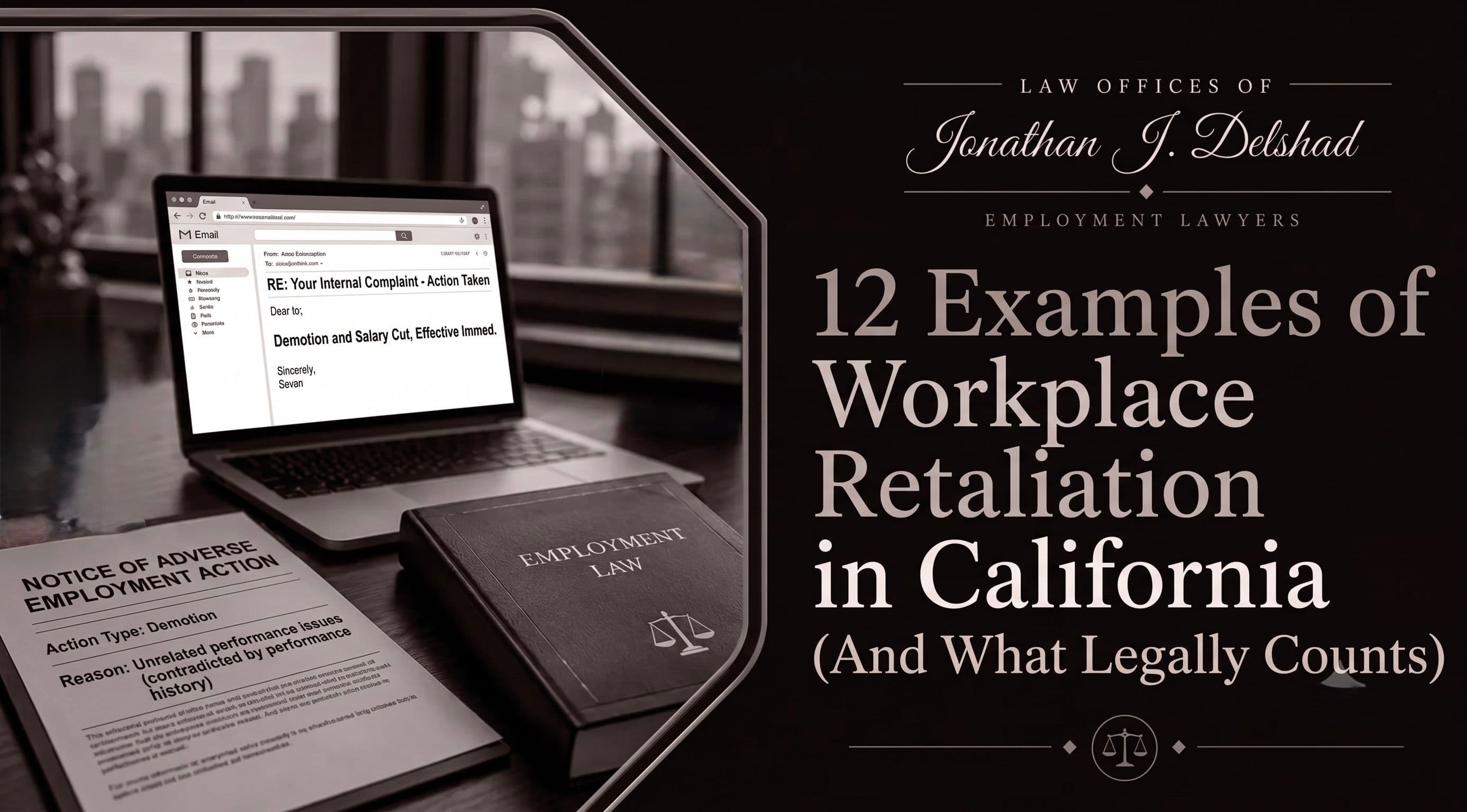
More than a firing. An adverse action is any employer action that would tend to discourage a reasonable worker from speaking up. That obviously includes termination, but it also includes demotion, a pay cut, a reduction in hours, a sudden negative performance review, being passed over for a promotion, an undesirable transfer or shift change, exclusion from meetings or projects, discipline, and a hostile change in how you are treated. Even a pattern of smaller actions can add up to retaliation when the cumulative effect is punishing. The question is whether the employer made your working life materially worse because you engaged in protected activity.
Why does timing matter so much?
Because retaliation is about motive, and timing is often the clearest window into motive. When an adverse action follows closely on the heels of your protected activity, that closeness in time can support an inference that the two are connected. A strong performer who suddenly receives a write-up days after reporting harassment, or who is "restructured" out weeks after requesting leave, presents exactly the kind of timeline that raises questions. Timing is not the only evidence, and a gap in time does not defeat a claim, but a tight sequence is powerful. This is why building a clear, dated timeline of events is one of the most useful things you can do. On a film or TV production, retaliation often shows up as not being called back for the next block, which our guide to retaliation in the entertainment industry covers.
What is not retaliation?
Not every unwelcome action is retaliation, and being honest about that helps you focus on real claims. An employer can still manage, discipline, and even terminate employees for legitimate reasons unrelated to protected activity. Poor performance that was documented before you complained, a genuine company-wide layoff that did not target you for speaking up, or ordinary policy enforcement applied evenly are generally lawful. Retaliation turns on the connection between your protected activity and the harm. If there is no protected activity, or no causal link, there is usually no retaliation claim, even if the treatment felt unfair. Sorting the two apart is a big part of what a case review does. That distinction reaches further than retaliation, because lawful management decisions are the ones workers’ compensation excludes too, which is why the question is whether the conduct was unlawful rather than whether it was upsetting.
How do I prove retaliation?
You usually build it from several threads rather than one smoking gun, and we will not pretend a web page can tell you whether your case is strong. Common building blocks include the timeline, a change in treatment after you spoke up, inconsistent or shifting explanations from the employer, comparisons to how coworkers who did not complain were treated, and any documents or messages reflecting the decision. Much of the strongest evidence is created in the moment, which is why preserving records early matters so much. Those threads are easier to assemble if you started collecting them early, so it is worth reading how to build an evidence file that holds up.
What to do if you think you are being retaliated against
- Write a dated timeline: what you reported or requested, to whom, and what happened afterward.
- Save emails, texts, reviews, write-ups, and policies. Keep your own copies, and do not access company systems after a separation.
- Keep doing your job well and follow legitimate instructions, so the employer cannot manufacture a performance reason.
- Note who knew about your protected activity and when.
- Talk to an employment lawyer promptly. Retaliation claims carry deadlines, and some are short. Do not calendar a date from a guide. Confirm it against your facts.
Frequently asked questions
What counts as retaliation after reporting a problem at work?
Retaliation is when your employer punishes you for protected activity, such as reporting harassment, discrimination, unpaid wages, or a safety issue. The punishment can be firing, but also demotion, a pay cut, a bad review, a schedule change, or other harmful actions taken because you spoke up.
Do I have to prove the harassment or violation I reported actually happened?
Generally no. You are usually protected if you reasonably and in good faith believed the conduct was unlawful and raised it, even if the underlying complaint is never proven.
Is it retaliation if I was not fired, just demoted or written up?
It can be. Retaliation is not limited to termination. Demotions, pay cuts, reduced hours, negative reviews, and other actions that would discourage a reasonable worker from speaking up can qualify.
How soon after I complain does retaliation usually happen?
There is no fixed rule, but a short gap between your protected activity and the adverse action is strong evidence. A longer gap does not defeat a claim, though it can make the connection harder to show.
How long do I have to take action?
It depends on the claim, and some deadlines are short, in some situations a year or less. Do not rely on a guide for your date. Speak with a lawyer promptly so it is calculated against your facts.
Were you punished for speaking up?
If your working life got worse after you reported harassment, discrimination, unpaid wages, or a safety concern, that timing is worth a closer look before a deadline passes. We represent employees, only employees, across California, and most of our work is in Los Angeles. The consultation is free. We handle most employment cases on a contingency-fee basis: you do not pay an attorney's fee unless we recover for you, and you are not responsible for the costs we advance if there is no recovery. We will explain the specific fee terms in writing before you decide to move forward.
Call (424) 255-8376 or contact us for a free, confidential consultation.
The Law Offices of Jonathan J. Delshad is a Los Angeles based employment law firm representing employees across California in wrongful termination, discrimination, retaliation, harassment, and wage and hour matters. Representing employees is the core of the firm's practice. Mr. Delshad is a lifetime member of the California Employment Lawyers Association (CELA), serves as Editor-in-Chief of the California Wrongful Termination Law Review, and trained at Latham & Watkins. Recognition includes Super Lawyers (2022 to 2027), Best Lawyers (since 2017), and an Avvo 10.0 "Superb" rating. Reviewed for California employment law accuracy. Last updated: September 17, 2026.
Attorney advertising. This article is educational only and is not legal advice. Reading it does not create an attorney-client relationship, which exists only under a signed engagement agreement. Every case is different, and outcomes depend on the specific facts. Deadlines can run early, so consult a lawyer promptly about your situation.