The General Release in Your Severance: 6 Clauses That Sign Away Real Money
The release of claims, not the check, is what a severance negotiation is really about. Here are the six clauses, from the Civil Code 1542 waiver to the tax indemnity terms, that determine whether the deal is actually fair.
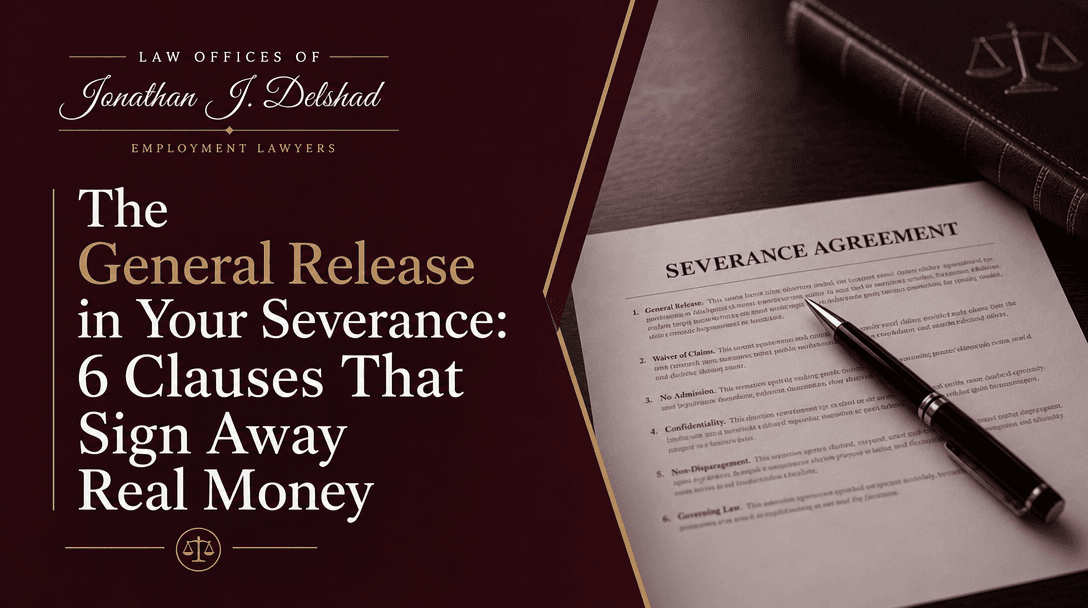
The release of claims, not the check, is what a severance negotiation is really about. Here are the six clauses, from the Civil Code 1542 waiver to the tax indemnity terms, that determine whether the deal is actually fair.
When you sign a severance agreement, the money is the part you notice. The release of claims is the part that actually costs you. A general release is the employer's whole reason for paying you: in exchange for the check, you give up your right to sue over almost anything that happened during your employment, sometimes including claims you do not even know you have. Most of the real value in a severance negotiation lives in these clauses, not in the dollar figure.
Here are the six clauses that quietly sign away the most, and what to look for in each.
At a glance
- A general release usually waives every legal claim you could bring against your employer as of the day you sign, including wage, discrimination, harassment, retaliation, and wrongful termination claims.
- A separate "unknown claims" waiver can give up claims you do not even know about yet.
- Some rights generally cannot be signed away, such as the right to file a charge with a government agency, to claim unemployment, and to claims that arise after you sign.
- The clauses that follow you, confidentiality, non-disparagement, no-rehire, and tax and indemnity terms, can cost you as much as the release itself.
What claims do I give up when I sign a severance agreement?
Our guide on how to negotiate severance in California covers leverage and timing. This one is about the release itself: generally, all of them, up to the date you sign. A standard general release waives every claim you could have brought against the employer as of that date, whether or not you have thought of it. That typically includes claims for unpaid wages and overtime, discrimination and harassment, retaliation, wrongful termination, and related theories. In exchange, you keep the severance. That trade can be entirely fair, or it can be a bad deal if the claims you are releasing are worth far more than the payment. The only way to know is to understand what is on both sides of the trade before you sign.
Now, the six clauses that carry the most weight.
Clause 1: The general release of claims
This is the heart of the agreement. Read how broad it is. A typical release covers all claims "known and unknown," arising from your employment and separation, against the company and a long list of related people and entities. The broader the language, the more you are giving up. Pay attention to whether it tries to reach claims that cannot legally be waived, and whether it is mutual, meaning the employer also releases claims against you. The size of what you are releasing is the single biggest factor in whether the severance is a good deal.
Clause 2: The waiver of unknown claims (Civil Code 1542)
This one surprises people. California Civil Code section 1542 normally protects you from unknowingly giving up claims you do not know about. Most general releases include an express waiver of section 1542, which means you are agreeing to release even claims you are unaware of at signing. So if you later discover something, for example that you were underpaid for years, that claim may already be gone. A 1542 waiver is common and often reasonable, but you should sign it knowing exactly what it does, not discover its effect later.
Clause 3: The confidentiality clause
A confidentiality or nondisclosure clause limits what you can say about the agreement, and sometimes about your employment. There are real limits on how far it can go. California law protects your right to discuss unlawful conduct in the workplace, so a clause that tries to stop you from talking about harassment, discrimination, or retaliation may be unenforceable or may require specific carve-out language. You can usually agree to keep the settlement amount private if you want to. What an employer cannot do is buy your silence about unlawful acts.
Clause 4: The non-disparagement clause
A non-disparagement clause says you will not make negative statements about the employer. Under California's Silenced No More Act, if a separation agreement includes one, it generally must also include language preserving your right to disclose information about unlawful acts in the workplace. If that carve-out is missing, the clause can be void. Watch for broad "no negative statements" language with no carve-out, and be cautious about one-sided clauses that bind you but not the employer. Our guide to NDAs after the Silenced No More Act covers this in more depth.
Clause 5: The no-rehire clause
A no-rehire clause says you will not be rehired by the company, and often its parents, affiliates, and subsidiaries. That can quietly close a lot of doors, especially with a large employer or a hospital or studio system. California limits these provisions in certain situations, particularly when you are settling a dispute you have raised, though in an ordinary severance they are often enforceable. If your industry is dominated by a few large employers, this clause can be worth more to you than a few extra weeks of pay.
Clause 6: The tax and indemnity clause
This is where a release can cost you actual cash after the fact. Severance is taxable, and the agreement will describe how the payment is characterized and reported. Watch for an indemnity provision that shifts tax liability onto you, meaning if the taxing authorities later disagree with how the payment was treated, you agree to cover the employer's exposure. Combined with how the settlement is allocated, these terms can change how much of the money you actually keep. This is a clause worth reading closely, because it turns on real dollars.
One more to watch: the cooperation clause
Many agreements also include a cooperation clause requiring you to assist the employer later, for example in litigation or investigations, sometimes without meaningful compensation for your time. It is not always a dealbreaker, but it is an ongoing obligation you are taking on, and it belongs on your radar alongside the six above.
What you generally cannot be forced to give up
A release is powerful, but it is not unlimited. Some rights generally cannot be waived, including the right to file a charge or complaint with a government agency such as the California Civil Rights Department (CRD) (formerly DFEH) or the federal Equal Employment Opportunity Commission (EEOC), the right to claim unemployment benefits, workers' compensation rights outside the proper resolution process, vested retirement benefits, and claims that arise after you sign. If an agreement appears to strip these, that is a reason to have it reviewed rather than a reason to worry that you have already lost them.
What to do before you sign a release
- Read the release scope and the 1542 waiver first. Those define what you are actually giving up.
- Compare the value of the claims you would release against the money offered. This is where a review helps most.
- Check the confidentiality and non-disparagement clauses for the required carve-out.
- Look at the no-rehire, tax, and indemnity terms for hidden costs.
- Use your review time. Do not sign the same day, and confirm your deadline rather than calendaring it from a guide.
Frequently asked questions
What claims do I give up when I sign a severance agreement?
Generally all claims you could bring against the employer as of the signing date, including wage, discrimination, harassment, retaliation, and wrongful termination claims, and often unknown claims too if the release includes a Civil Code 1542 waiver. Some rights, like filing an agency charge or claiming unemployment, generally cannot be waived.
What is a Civil Code 1542 waiver?
A clause in which you agree to release even claims you do not know about at the time you sign. Without it, section 1542 would normally preserve unknown claims. With it, those claims can be gone.
Can a severance agreement stop me from talking about harassment?
Generally no. California law protects your right to discuss unlawful conduct, and non-disparagement or confidentiality clauses in separation agreements must include carve-out language preserving that right, or they can be unenforceable.
Is a no-rehire clause enforceable in California?
It depends. California limits no-rehire provisions in some situations, especially when settling a dispute you raised, but in an ordinary severance they are often enforceable. They can matter a lot when a few large employers dominate your field.
Should I have a lawyer review the release before I sign?
It is worth considering, especially when the package is large, when there is equity or a bonus, or when anything about your separation feels off. The value of what you are releasing is the biggest driver of whether the deal is fair.
Have the release reviewed before you sign
The release, not the dollar amount, is what determines whether your severance is a good deal. If you have an agreement in hand, it is worth a focused review before you sign anything. We represent employees, only employees, across California, and most of our work is in Los Angeles. The consultation is free, and a severance review is usually handled as a focused, flat-fee engagement, with the fee terms explained in writing before you decide.
Call (424) 255-8376 or send us your agreement through our contact form, and we will tell you what you would be giving up.
The Law Offices of Jonathan J. Delshad is a Los Angeles based employment law firm representing employees across California in wrongful termination, discrimination, retaliation, harassment, and wage and hour matters. Representing employees is the core of the firm's practice. Mr. Delshad is a lifetime member of the California Employment Lawyers Association (CELA), serves as Editor-in-Chief of the California Wrongful Termination Law Review, and trained at Latham & Watkins. Recognition includes Super Lawyers (2022 to 2027), Best Lawyers (since 2017), and an Avvo 10.0 "Superb" rating. Reviewed for California employment law accuracy. Last updated: July 13, 2026.
Attorney advertising. This article is educational only and is not legal advice. Reading it does not create an attorney-client relationship, which exists only under a signed engagement agreement. Every case is different, and outcomes depend on the specific facts. Deadlines can run early, so consult a lawyer promptly about your situation.