12 Examples of Workplace Retaliation in California (And What Legally Counts)
Firing, demotion, a pay or hours cut, a sudden bad review, exclusion, closer scrutiny, threats. Twelve patterns of workplace retaliation in California, and what makes each one unlawful.
Firing, demotion, a pay or hours cut, a sudden bad review, exclusion, closer scrutiny, threats. Twelve patterns of workplace retaliation in California, and what makes each one unlawful.
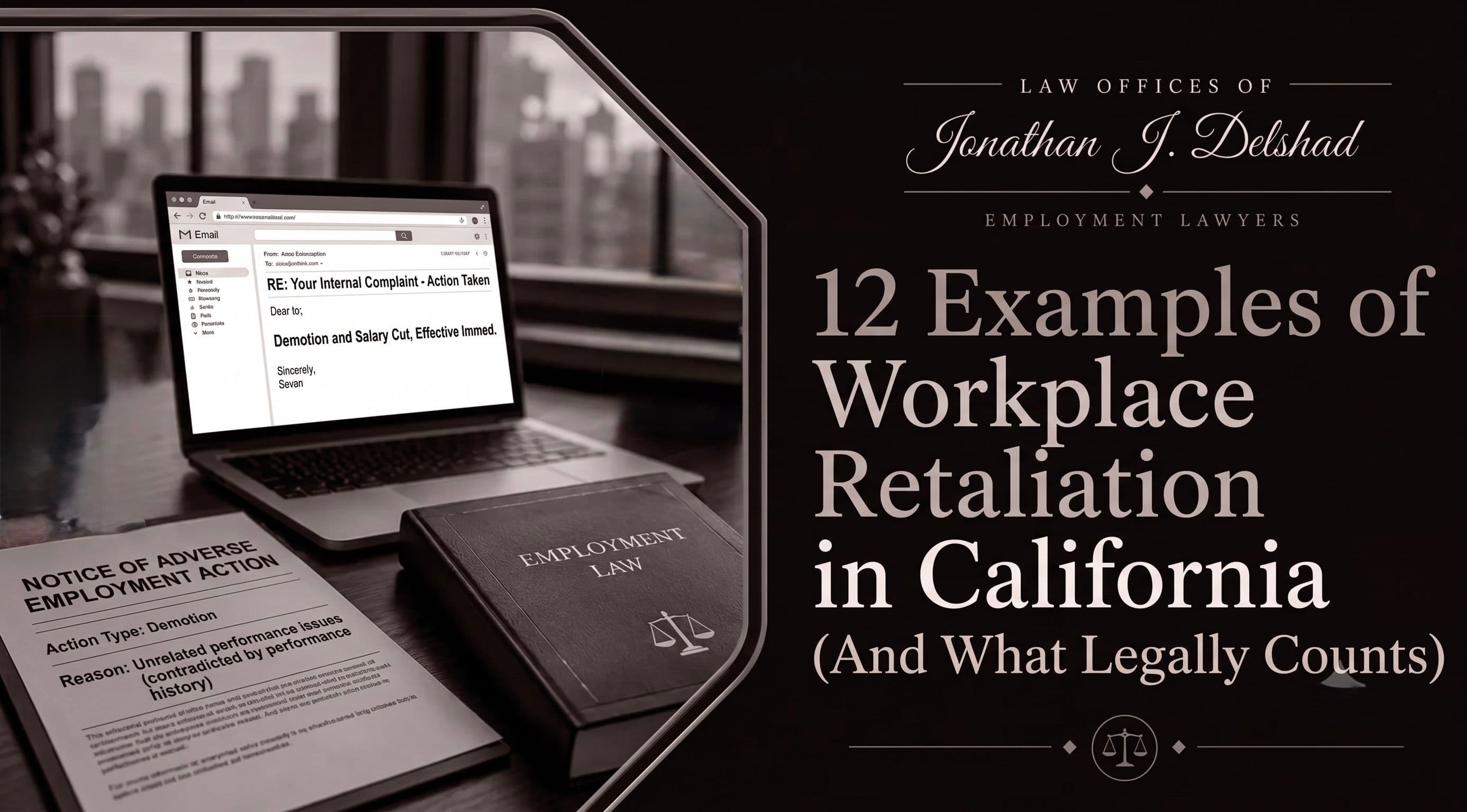
Retaliation is punishment for speaking up. The examples California workers bring us most often are a firing, a demotion, a pay or hours cut, a sudden bad review after years of good ones, a write-up nobody else gets, losing duties or clients, being cut out of the room, closer scrutiny, a worse schedule, threats, and being pushed into quitting. What makes it unlawful is the reason and the timing.
At a glance
- A California retaliation claim has three parts: you did something the law protects, your employer did something bad to you, and the two are connected. The California Supreme Court restated those elements in Yanowitz v. L'Oreal USA, Inc. (2005).
- The bad thing has to be more than an annoyance. It must materially affect the terms, conditions, or privileges of your employment.
- Timing carries real legal weight in California. If the punishment lands within 90 days of your protected complaint, Labor Code section 98.6 gives you a rebuttable presumption in your favor, meaning your employer has to come forward and disprove it.
- You do not have to be right about the violation you reported. What the law protects is raising it in a reasonable, good faith belief that something was wrong.
- Retaliation is a claim of its own. It stands even if the discrimination or wage violation you complained about is never proven.
| What people assume | What California law says |
|---|---|
| Only being fired counts as retaliation | An adverse action is anything materially affecting the terms or conditions of employment |
| You have to prove the complaint was correct | Reporting in good faith is protected even if the violation is never proven |
| Timing on its own proves nothing | Labor Code 98.6 gives a 90 day rebuttable presumption in your favor |
| That presumption covers every retaliation claim | Section 1102.5 does not carry it |
| Resigning ends the claim | Constructive discharge can count where the employer created the intolerable conditions, or knew about them and failed to fix them |
What counts as retaliation in California?
Three things have to line up.
First, protected activity. That means reporting or opposing discrimination or harassment, filing or supporting a claim, asking for a disability or religious accommodation, taking protected leave, raising a wage or safety problem, or refusing to do something unlawful. In Yanowitz, an employee refused a supervisor's order to fire a saleswoman he thought was not sufficiently attractive. The court held that refusing an order you reasonably believe is discriminatory is protected activity, so long as the employer knows that is why you refused.
Second, an adverse action. Under Government Code section 12940(h) and Yanowitz, it has to be something that materially affects the terms, conditions, or privileges of employment.
Third, a causal link between the two.
One protected complaint has its own article on this site, because the pattern that follows it is so distinct: if what you refused was a sexual demand from someone with power over your job, see quid pro quo sexual harassment.
Our main article on California retaliation law walks through the legal framework. This page is the other half of the question: what the twelve patterns we see most often actually look like on the ground.
Every illustration below is written to be recognizable. None is a client matter.
1. You are fired soon after you complain
The plainest example, and still the most common. You report harassment, ask about unpaid overtime, or file a workers' compensation claim, and within weeks the job ends. On a film or TV production, it often looks like not being called back instead; see our guide to being fired for reporting harassment on set.
Employers rarely say why. What usually appears is a reason that did not exist before you spoke: a performance problem, a restructure, a policy you supposedly broke.
If that reason is a false accusation, such as theft or falsified records, and it was told to other people, it can also be defamation. Our guide to workplace defamation in California explains when, and why the deadline to sue is generally one year.
What matters: the gap in days between your complaint and the decision, and whether the stated reason has any paper trail older than your complaint.
2. A demotion, or a "lateral move" that is really a demotion
Titles are easy to keep. Authority is not.
Illustration: a supervisor reports a safety hazard to Cal/OSHA. Two months later she keeps her title and salary but loses her direct reports, and her new duties are the ones she did six years ago.
A move sold as lateral can still be an adverse action if it strips responsibility, visibility, or a path to promotion.
3. A pay cut, a lost commission, or a worse territory
A change in pay is usually the easiest kind of retaliation to document, because payroll keeps the record for you. Cutting a commission rate, reassigning the accounts that generated it, or moving a salesperson to a thin territory all reduce pay without a formal pay cut. If a commission was earned and then simply never paid, that is a wage claim rather than a retaliation claim, and what California requires an employer to put in writing about commissions decides most of those arguments.
4. Losing shifts, hours, or overtime
For hourly workers this is often the whole case. Your availability does not change, but your name stops appearing on the schedule, or the overtime that made the job workable goes to someone else.
Labor Code section 98.6 protects you when you complain that you are owed unpaid wages, and its language is broad enough to cover a cut in hours as an adverse action.
5. A sudden bad performance review
Four years of "exceeds expectations," one complaint to HR, and then a review that reads as though a different person wrote it.
This is the pattern employers create for themselves. The review is meant to justify what comes next, which means it also documents the change in treatment and the date it started.
What matters: what your file said before you complained, and who wrote the new review.
6. Write-ups for rules nobody else is written up for
Being held to a real policy is not retaliation. Being the only person held to it is a different matter.
Illustration: a warehouse worker raises a wage complaint. He is then written up twice in a month for clocking in four minutes late, on a crew where late clock-ins had never been documented for anyone.
7. A worse schedule, shift, or work location
The graveyard shift. A site an extra hour away. A schedule that collides with the childcare or school run your employer knows about. The federal Equal Employment Opportunity Commission (EEOC) lists exactly this kind of move, changing someone's schedule to conflict with family responsibilities, among the actions that can be retaliation.
8. Being stripped of duties, clients, or your team
Sometimes nothing is taken away formally. The work simply stops arriving.
Accounts get reassigned. The project you led goes to someone else. You keep the salary and lose the job, which is a real adverse action when it changes what your role is worth on the market.
9. Being cut out
You are dropped from the meetings you used to run. You stop being copied on the emails you need. Training goes to other people, and so does the promotion.
Exclusion leaves less of a paper trail than a firing. It leaves more than most people expect, because calendars and email threads keep their own record.
10. Suddenly being watched much more closely
Your work is checked in a way it never was. Your breaks are timed. Someone starts asking your co-workers about you.
The EEOC lists increasing scrutiny among the actions that can be retaliation when they follow protected activity. On its own it may not be enough. Alongside a review that changed and a shift that moved, it usually is.
11. Threats, including threats aimed at your immigration status or your family
A threat can be an adverse action even if the employer never carries it out, because it is the kind of thing that would stop a reasonable person from speaking up again.
California treats immigration-related threats separately and severely. Under Labor Code section 1019, threatening to contact or contacting immigration authorities is an unfair immigration-related practice when it is done to retaliate against someone for exercising a right under the Labor Code. So is threatening to file a false police report. Section 1019 carries its own 90-day rule: an unfair immigration-related practice within 90 days of your exercising a right protected by the Labor Code, or by a local ordinance that applies to employees, raises a rebuttable presumption that it was done in retaliation.
12. Being pushed into quitting
If conditions are made bad enough that you resign, the law can treat that resignation as a firing. California calls it constructive discharge. Proving it is harder than the name suggests, and it turns on two things: intolerable conditions, and that you resigned because of them.
The standard is high. Under Turner v. Anheuser-Busch, Inc. (1994) you have to show that your employer either intentionally created or knowingly permitted conditions so intolerable or aggravated that a reasonable employer would realize a reasonable person in your position would be compelled to resign. "Unpleasant" does not reach it, and neither does one bad review. A sustained campaign that begins the week after you file a complaint sometimes does.
Ready to talk it through? If several of these have happened to you in sequence, that sequence is worth having reviewed. Tell us what happened.
What does not count as retaliation?
Plenty of bad workplace behavior is lawful.
A manager who is rude, unfair, or wrong is not retaliating unless the treatment is punishment for protected activity. A layoff that hits your whole department is usually not retaliation, though it can be if the selection was aimed at you. Being disciplined for a real performance problem, documented before you complained, generally stands. Where the problem is a toxic manager rather than punishment for a complaint, the four routes by which a toxic workplace becomes unlawful in California are set out in our guide to toxic work environments.
Two more that surprise people. Complaining about a boss you find difficult is not by itself protected activity, because a personality clash is not a legal violation. And a minor slight, with no effect on your pay, duties, or prospects, will usually fall short of the material standard Yanowitz set.
Why does timing matter so much in California?
Because the Legislature made it matter. Senate Bill 497 added a 90-day rule to Labor Code section 98.6, effective January 1, 2024: "If an employer engages in any action prohibited by this section within 90 days of the protected activity specified in this section, there shall be a rebuttable presumption in favor of the employee's claim." The same sentence went into section 1197.5, the equal pay statute. Because section 98.6 reaches wage complaints and the disclosures protected by the whistleblower statute, that window covers most retaliation for speaking up about pay or unlawful conduct.
That puts your employer on the back foot inside the 90-day window. It has to come forward with its non-retaliatory reason and rebut the presumption, rather than sit back and wait for you to disprove one.
California's whistleblower statute, Labor Code section 1102.5, works differently and is also in your favor. Under Labor Code section 1102.6, once you show your protected activity was a contributing factor in what happened to you, meaning it does not have to be the only reason, your employer must prove by clear and convincing evidence, a higher bar than the usual one, that it would have done the same thing anyway for legitimate, independent reasons. For the whole statute, including what counts as a protected report and the deadlines, see our guide to Labor Code 1102.5.
Retaliation outside 90 days is still unlawful. It just does not carry the presumption, so the pattern has to do more of the work.
How do you prove retaliation?
With dates, mostly.
Write down what you reported, to whom, in what form, and when. Keep your own copies of reviews, schedules, pay stubs, and messages, stored somewhere outside company systems. Note the day each change happened and who made it. There is a method to this, and what to capture for each incident, and the records you can compel walks through it step by step.
Then look for the same signals a lawyer looks for: the interval between your complaint and the punishment, whether the stated reason shifted, whether comparable co-workers were treated differently, and whether a written policy was skipped for you.
Direct evidence is rare. Almost no employer writes down that it punished you for complaining. Most retaliation cases are built from a timeline, which is why one dated page from you is worth more than any article.
How long do I have to file a retaliation claim in California?
It depends which law protects your complaint, and the clocks run at different speeds.
For retaliation under the Fair Employment and Housing Act (FEHA), such as punishment for reporting discrimination or harassment, Government Code section 12960 gives you three years from the unlawful act to file a complaint with the California Civil Rights Department (CRD) (formerly DFEH). The CRD then investigates. When it finishes, or if you ask for it earlier, it issues a right-to-sue notice, which is the letter that clears you to sue. Section 12965 gives you one year from the date of that notice to file in court.
For complaints in the Labor Commissioner's jurisdiction, such as wage retaliation, Labor Code section 98.7 gives you one year from the violation, extendable for good cause. That route is optional. The same section says there is no requirement to exhaust it before going to court.
Some clocks start earlier than the day you were punished. Our article on how long you have to file breaks each one down. Do not calendar a date from an article. Deadlines can run early, so confirm yours with us before you rely on it.
Frequently asked questions
What are examples of illegal workplace retaliation in California?
Firing, demotion, a pay or commission cut, reduced hours or shifts, a sudden negative performance review, selective write-ups, a worse schedule or work location, removal of duties or accounts, exclusion from meetings and training, increased scrutiny, threats, and conditions bad enough to force a resignation. Each has to be a response to protected activity, and it has to materially affect your employment.
Can my employer retaliate if my complaint turns out to be wrong?
No. What the law protects is raising the concern in a reasonable, good faith belief that something was wrong. Your retaliation claim can succeed even if the discrimination or wage violation you reported is never proven.
Is retaliation illegal if I was not fired, only demoted or written up?
Yes. Termination is not required. Any action that materially affects the terms, conditions, or privileges of your employment can qualify, which is why demotions, pay cuts, and schedule changes are all actionable.
How soon after a complaint does retaliation usually happen?
Often within weeks. California gives that timing legal significance: an adverse action within 90 days of protected activity carries a rebuttable presumption in the employee's favor under Labor Code section 98.6, meaning the employer has to come forward and disprove it.
Does my employer have to be big enough for FEHA to apply?
For discrimination and retaliation claims, FEHA's definition of employer generally covers employers who regularly employ five or more people. The Labor Code retaliation protections, including sections 98.6, 1102.5, and 6310, have no such headcount threshold.
What about retaliation for a safety complaint?
Labor Code section 6310 covers complaints about health and safety, made to your employer, or to Cal/OSHA or another agency responsible for workplace safety. An employee retaliated against under that section is entitled to reinstatement and reimbursement for lost wages and work benefits.
Is a bad manager the same as retaliation?
No. Rudeness, favoritism, and poor management are not unlawful on their own. The question is whether the treatment is punishment for something the law protects, and whether it changed after you spoke up.
What should I do first if I think this is happening to me?
Write the timeline while you still remember the dates, keep copies of documents outside company systems, and put any further complaint in writing. Then get the facts reviewed before a deadline passes.
Does one of these describe your situation?
If the treatment changed after you reported something, the sequence is worth having reviewed. We represent employees, only employees, across California, and most of our work is in Los Angeles. The consultation is free. We handle most employment cases on a contingency-fee basis: you do not pay an attorney's fee unless we recover for you, and you are not responsible for the costs we advance if there is no recovery. We will explain the specific fee terms in writing before you decide to move forward.
Call (424) 255-8376 or contact us for a free, confidential case review.
The Law Offices of Jonathan J. Delshad is a Los Angeles based employment law firm representing employees across California in wrongful termination, discrimination, retaliation, harassment, and wage and hour matters. Representing employees is the core of the firm's practice. Mr. Delshad is a lifetime member of the California Employment Lawyers Association (CELA), serves as Editor-in-Chief of the California Wrongful Termination Law Review, and trained at Latham & Watkins. Recognition includes Super Lawyers (2022 to 2027), Best Lawyers (since 2017), and an Avvo 10.0 "Superb" rating. Reviewed for California employment law accuracy. Last updated: July 31, 2026.
Attorney advertising. This article is educational only and is not legal advice. Reading it does not create an attorney-client relationship, which exists only under a signed engagement agreement. Every case is different, and outcomes depend on the specific facts. Deadlines can run early, so consult a lawyer promptly about your situation.