Unpaid Wages in California Just Got Expensive for Employers: SB 261's Triple Penalties
If you won a California wage judgment and your employer just ignores it, SB 261 changed the math. As of January 1, 2026, a court can add a penalty of up to three times an unpaid wage judgment once it has gone unpaid for 180 days, on top of the original amount and interest, plus mandatory attorneys’ fees.
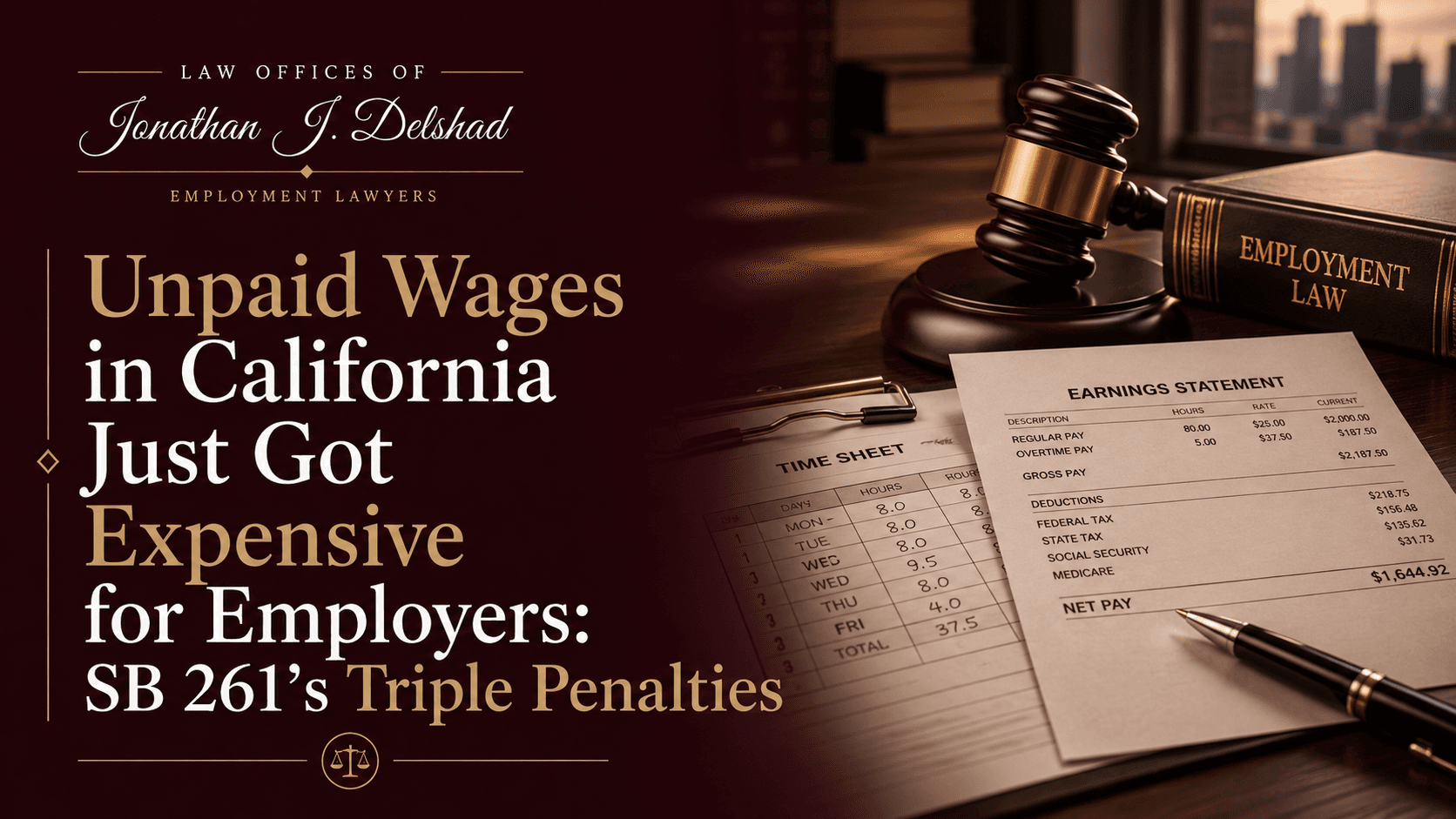
If you won a California wage judgment and your employer just ignores it, SB 261 changed the math. As of January 1, 2026, a court can add a penalty of up to three times an unpaid wage judgment once it has gone unpaid for 180 days, on top of the original amount and interest, plus mandatory attorneys’ fees.
If you won a wage judgment in California and your employer is just ignoring it, the law changed in your favor. As of January 1, 2026, a new law called SB 261 lets a court hit an employer with a penalty of up to three times an unpaid wage judgment once it has gone unpaid for 180 days, on top of the original amount and interest. For years, many workers who won never actually got paid. SB 261 is designed to change that by making it far more expensive for an employer to stall. If you are earlier in the process and simply have not been paid, start with the deadlines and penalties that apply to a late final paycheck.
Here is what the law does and what it means if your employer owes you a judgment.
At a glance
- SB 261 took effect January 1, 2026. If a final wage judgment stays unpaid for 180 days after the appeal period ends, a court can add a penalty of up to three times the outstanding amount.
- The court is directed to impose the full penalty unless the employer proves “good cause” to reduce it, which is a high bar.
- The law also makes attorneys’ fees and costs mandatory for collection actions and extends liability to successor businesses, so a sale or reorganization does not erase it.
- Half of any penalty goes to the affected worker. An employer can avoid it only by paying or by setting up and following a written payment plan before the 180-day deadline.
What happens if my employer ignores a wage judgment in California?
Under SB 261, it becomes very costly for them. Once you have a final, non-appealable judgment for unpaid wages, the employer has a 180-day clock, running from when the time to appeal expires, to satisfy it. If the judgment is still unpaid after 180 days, a court can impose a civil penalty of up to three times the outstanding judgment, including principal and accrued interest. So an employer who drags out a $40,000 judgment past the deadline can face a penalty that turns it into far more. This is a major shift from the old system, where interest alone often was not enough to make an employer pay.
What is SB 261?
SB 261 is a California law signed in October 2025 and effective January 1, 2026. It amends the Labor Code to strengthen the collection of final judgments for unpaid wages, which the Legislature acted on after finding that only a small fraction of wage judgments were ever fully collected. In plain terms, it puts real financial teeth behind a judgment you have already won, so that “we just will not pay” stops being a workable strategy for an employer.
How does the triple penalty work?
A few mechanics matter:
- The trigger. A final wage judgment that remains unsatisfied for 180 days after the appeal period expires, with no appeal pending.
- The amount. A civil penalty of up to three times the outstanding judgment, including interest.
- The presumption. The court is directed to assess the full penalty unless the employer shows, by clear and convincing evidence, that there is good cause to reduce it. Ordinary cash-flow problems or a choice to prioritize other bills generally do not qualify.
- Where it goes. Half of any penalty goes to the affected worker, with the remainder directed as the law provides.
Can the employer avoid the penalty?
Yes, but only by acting before the deadline. The straightforward way is to pay the judgment in full within the 180 days. If the employer cannot pay a lump sum, the law provides an “accord” path: if the employer reaches a formal, written installment payment plan with the worker and stays in compliance with it before the 180-day deadline, it is shielded from the penalty. Informal delays, partial payments, or vague promises generally do not count. From your side as the worker, this means a genuine, documented payment plan is a real option, but you are not obligated to accept an inadequate one.
What else does SB 261 do for workers?
Two features add real leverage:
- Mandatory attorneys’ fees and costs. In an action to collect a final wage judgment, the prevailing party is awarded reasonable attorneys’ fees and costs. That makes it far more practical to pursue an employer who will not pay, whether the collection is pursued by you, the Labor Commissioner, or a public prosecutor.
- Successor liability. The penalties can follow to a successor business. An employer generally cannot escape the judgment by restructuring, selling assets, or reopening under a new name.
Together, these tools are meant to close the gap between winning a wage judgment and actually collecting it. If you are earlier than that and have no judgment yet, start with what counts as wage theft and how to bring the claim.
What to do if you have an unpaid wage judgment
- Locate your judgment or the Labor Commissioner’s order, decision, or award, and note when the appeal period ended.
- Track the 180-day clock from that date, and keep records of every payment or promise the employer makes.
- Do not accept a vague or partial payment arrangement as a substitute for a proper written plan without understanding your rights.
- Talk to an employment lawyer promptly about enforcing the judgment. Collection has its own steps and deadlines, and acting sooner protects your leverage.
Frequently asked questions
What happens if my employer ignores a wage judgment in California?
Under SB 261, if a final wage judgment goes unpaid for 180 days after the appeal period ends, a court can impose a penalty of up to three times the outstanding amount, plus mandatory attorneys’ fees. Half of the penalty goes to the worker.
When did SB 261 take effect?
January 1, 2026. It applies to the enforcement of final wage judgments and adds the new penalty framework described above.
How long does my employer have to pay before the penalty applies?
180 days, measured from when the time to appeal the judgment expires with no appeal pending. If it is still unpaid after that, the triple penalty can apply.
Can my employer get out of it by paying in installments?
Only through a proper, written payment plan (an “accord”) that they enter into and comply with before the 180-day deadline. Informal or partial payments generally do not provide protection.
Can the employer avoid it by closing or selling the business?
Generally no. SB 261 extends liability to successor businesses, so a sale, merger, or reorganization does not erase the judgment or the penalties.
Is your employer refusing to pay what you are owed?
If you have a wage judgment your employer is ignoring, the law now gives you far stronger tools to collect, and the clock matters. We represent employees, only employees, across California, and most of our work is in Los Angeles. The consultation is free. We handle most employment cases on a contingency-fee basis: you do not pay an attorney’s fee unless we recover for you, and you are not responsible for the costs we advance if there is no recovery. We will explain the specific fee terms in writing before you decide to move forward.
Call (424) 255-8376 or contact us for a free, confidential consultation.
The Law Offices of Jonathan J. Delshad is a Los Angeles based employment law firm representing employees across California in wrongful termination, discrimination, retaliation, harassment, and wage and hour matters. Representing employees is the core of the firm’s practice. Mr. Delshad is a lifetime member of the California Employment Lawyers Association (CELA), serves as Editor-in-Chief of the California Wrongful Termination Law Review, and trained at Latham & Watkins. Recognition includes Super Lawyers (2022 to 2027), Best Lawyers (since 2017), and an Avvo 10.0 “Superb” rating. Reviewed for California employment law accuracy. Last updated: July 14, 2026.
Attorney advertising. This article is educational only and is not legal advice. Reading it does not create an attorney-client relationship, which exists only under a signed engagement agreement. Every case is different, and outcomes depend on the specific facts. Deadlines can run early, so consult a lawyer promptly about your situation.