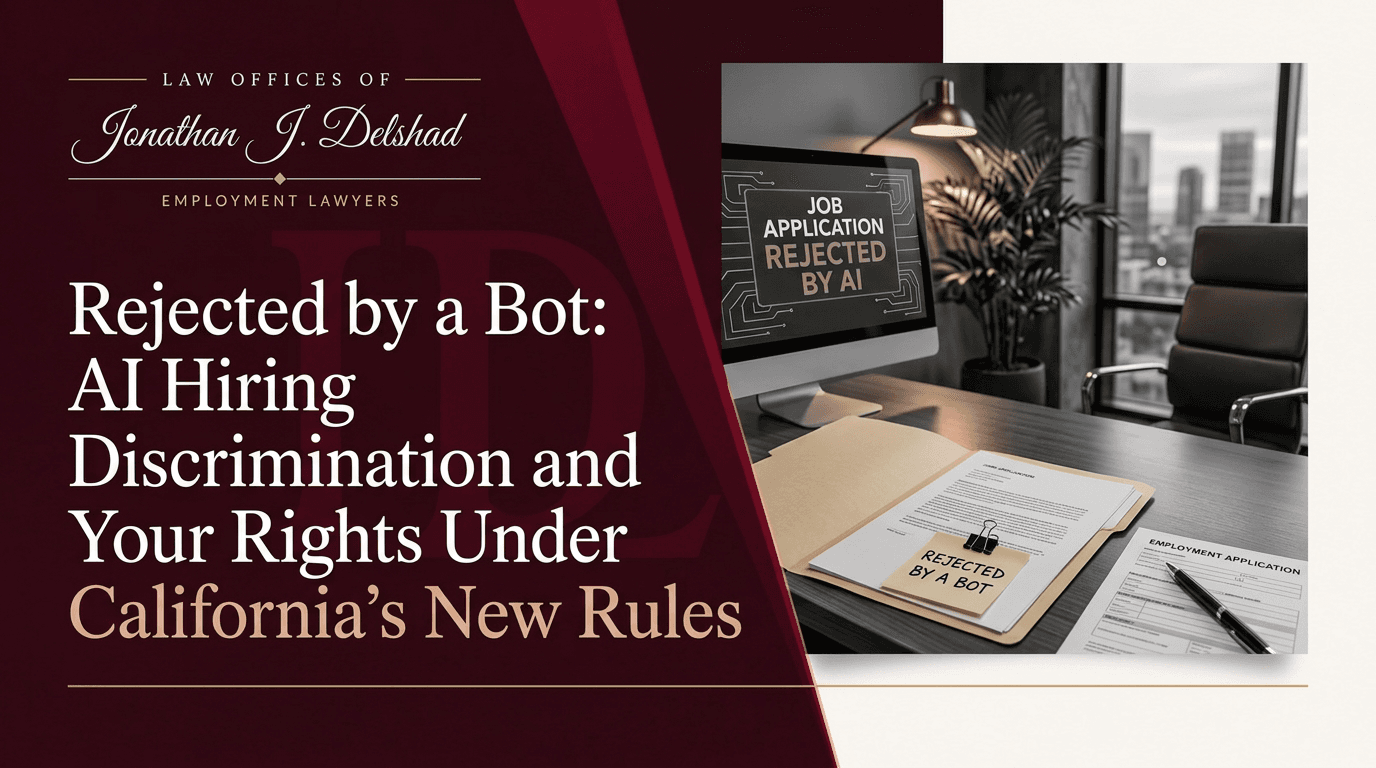
Rejected by a Bot: AI Hiring Discrimination and Your Rights Under California's New Rules
If an AI hiring tool screened you out because of your race, age, disability, sex, or national origin, that can violate California's FEHA, and as of October 2025, the vendor that built the tool can share the liability too.
If an AI hiring tool screened you out because of your race, age, disability, sex, or national origin, that can violate California's FEHA, and as of October 2025, the vendor that built the tool can share the liability too.
Possibly, yes, you can sue if an AI hiring tool discriminated against you. If an automated system screened you out or scored you down because of a protected characteristic like your race, age, disability, sex, or national origin, that can violate California's Fair Employment and Housing Act (FEHA). As of October 1, 2025, state regulations make clear the law applies fully to these automated tools, and even the company that built the tool can share the liability. Being rejected by software is not the same as being rejected lawfully.
Here is how AI hiring discrimination works in California, how to spot it, and what your options are.
At a glance
- California law does not ban AI in hiring, but it prohibits automated tools that discriminate against applicants based on a protected characteristic, whether the bias was intended or not.
- Regulations effective October 1, 2025 confirm FEHA applies to automated hiring tools and extend liability to the vendors and staffing firms that build or run them.
- Applicants are protected, not just employees. That includes people who were deterred from applying by a discriminatory process.
- A hiring assessment that probes your health or disability, or a game that does, can be an unlawful medical inquiry before a job offer.
Can I sue if an AI hiring tool discriminated against me?
You may be able to. FEHA protects job applicants, not only current employees, from discrimination based on protected characteristics. If an automated hiring tool rejected or downgraded you because of a protected trait, or produced a pattern that fell disproportionately on a protected group, that can be an unlawful employment practice. The general path for a FEHA claim is to file a complaint with the California Civil Rights Department (CRD) (formerly DFEH) and obtain a right-to-sue notice before going to court, though the details and deadlines depend on your facts. Whether you have a viable claim is exactly the kind of question worth reviewing with a lawyer.
What counts as an "automated decision system" in hiring?
California's Civil Rights Council regulations, effective October 1, 2025, use the term automated-decision system, or ADS, defined broadly as a computational process that makes or helps make a decision about an employment benefit. In hiring, that sweeps in a lot of common tools:
- Resume screeners that scan for keywords, patterns, or "fit."
- Ranking and scoring systems that sort applicants.
- One-way video interviews that analyze facial expressions, word choice, or voice.
- Gamified assessments, puzzles, and personality tests used to filter candidates.
- Chatbots and automated schedulers that route or reject applicants.
The rules apply to employers with 5 or more employees, the same broad threshold as the rest of FEHA. They do not outlaw these tools. They make clear that using one in a way that discriminates is unlawful.
How does an AI hiring tool end up discriminating?
Often through disparate impact, which is a neutral-looking process that lands harder on a protected group. A model trained on a company's past hires can learn and repeat old biases, for example by favoring patterns associated with younger applicants or a particular gender. A video-analysis tool can disadvantage applicants with disabilities, accents, or speech differences. A resume screener can penalize gaps that correlate with caregiving or medical leave. None of that requires anyone to intend to discriminate. Under FEHA, the discriminatory result can be enough.
There are also more direct problems. An assessment built around a test, question, puzzle, or game that is likely to reveal a disability can count as an unlawful medical or psychological inquiry when it is used before a job offer. And limits on asking about criminal history apply even when the questions are asked through an automated tool.
Can the company that made the AI be liable too?
Yes, and this is one of the most important parts of the 2025 rules. Liability for discrimination through an ADS extends to an employer's "agents," which can include the third-party vendors that build the tool and the staffing firms that run it on the employer's behalf. So responsibility does not stop with the company you applied to. That broader net can matter a great deal when it comes to who is accountable for a biased system.
Signs an AI tool may have affected your application
You often will not be told that software rejected you, but some patterns are worth noting:
- You were asked to complete a one-way recorded video interview scored without a human, or a timed game or puzzle assessment.
- You were rejected almost instantly, before any person could have reviewed your materials.
- The assessment seemed to probe your health, mood, focus, or a condition.
- You requested a disability accommodation for an online assessment and it was ignored or refused.
- You belong to a protected group and noticed a pattern in who advanced and who did not.
None of these proves discrimination on its own. Together, and against the fuller picture, they can be worth a closer look.
What about a disability accommodation for AI assessments?
If a disability makes an automated assessment inaccessible or inaccurate for you, you can generally request a reasonable accommodation, such as an alternative format or a different way to demonstrate your qualifications. An employer's duty to provide reasonable accommodation and to engage in a good-faith interactive process does not disappear because a machine is administering the test. Refusing to accommodate, or penalizing you for needing one, can itself be a FEHA problem.
How do I know if my rejection was unlawful?
You usually cannot tell from the outside, and we will not pretend a web page can. What tends to matter is what tool was used, what data and criteria it relied on, whether the outcome fell disproportionately on a protected group, and whether the employer tested it for bias. Much of that sits in records the employer must now preserve for four years, including the tool's inputs, outputs, and selection criteria. The practical step is to save your own materials and have the facts reviewed before a deadline passes.
What to do if you think an AI tool discriminated against you
- Save the job posting, your application, any assessment or video-interview invitations, and the rejection message. Note dates and the tools or platforms involved.
- Write down anything you were told about how candidates were screened, scored, or assessed.
- If you requested an accommodation, keep that request and any response.
- Talk to an employment lawyer promptly, because discrimination claims carry deadlines and some are short. Do not calendar a date from a guide. Confirm it against your facts.
Frequently asked questions
Can I sue if an AI hiring tool discriminated against me?
You may be able to. FEHA protects applicants from discrimination based on protected characteristics, and California's 2025 regulations confirm it applies to automated hiring tools. Whether you have a viable claim depends on the facts, which is worth reviewing.
Is it legal for employers to use AI to screen job applicants?
Generally yes, as long as the tool does not discriminate. Using automated screening is lawful, but a tool that rejects or downgrades applicants based on a protected trait, directly or through a disparate impact, can violate FEHA.
Do applicants have rights, or only employees?
Applicants are protected under FEHA. That protection can even reach people who were deterred from applying by a discriminatory practice.
Can an AI assessment ask about my health or disability?
Not before a job offer, generally. A test, question, puzzle, or game that is likely to elicit information about a disability can be treated as an unlawful medical inquiry when used at the screening stage.
How long do I have to take action?
It depends on the claim, and some deadlines are short. Do not rely on a guide for your date. Speak with a lawyer promptly so it is calculated against your actual facts.
Were you screened out by an AI hiring tool?
If you believe an automated hiring process rejected you because of your race, age, disability, sex, national origin, or another protected trait, it is worth having the facts reviewed before a deadline passes. We represent employees and applicants, on the employee side only, across California, and most of our work is in Los Angeles. The consultation is free. We handle most employment cases on a contingency-fee basis: you do not pay an attorney's fee unless we recover for you, and you are not responsible for the costs we advance if there is no recovery. We will explain the specific fee terms in writing before you decide to move forward.
Call (424) 255-8376 or contact us for a free, confidential case review.
The Law Offices of Jonathan J. Delshad is a Los Angeles based employment law firm representing employees across California in wrongful termination, discrimination, retaliation, harassment, and wage and hour matters. Representing employees is the core of the firm's practice. Mr. Delshad is a lifetime member of the California Employment Lawyers Association (CELA), serves as Editor-in-Chief of the California Wrongful Termination Law Review, and trained at Latham & Watkins. Recognition includes Super Lawyers (2022 to 2027), Best Lawyers (since 2017), and an Avvo 10.0 "Superb" rating. Reviewed for California employment law accuracy. Last updated: July 8, 2026.
Attorney advertising. This article is educational only and is not legal advice. Reading it does not create an attorney-client relationship, which exists only under a signed engagement agreement. Every case is different, and outcomes depend on the specific facts. Deadlines can run early, so consult a lawyer promptly about your situation.